Cosmology, Physics, the Big Bang, and what the bloody hell does this all have to do with this thing: The LHC (Large Hadron Collider)
There are very BIG questions still looming around and plaguing the scientists of today that have also plagued those of yesteryear. Some of these questions will hopefully be answered if the LHC is, as expected, able to actually reconstruct, "on a micro-scale, conditions that existed during the first billionth of a second of the Big Bang." It's going to smash particles together at speeds %99.999 near the speed of light in order to accomplish this task, and they need this big fucker to do it:

The collider is contained in a circular tunnel with a circumference of 27 kilometres (17 mi) at a depth ranging from 50 to 175 metres underground. Large Hadron Collider - Wikipedia, the free encyclopedia
I hate to say it, but it may be hard to fully appreciate the scope of this without realizing the mind-boggling questions the LHC may answer, and the new ones it may give rise to. So in an effort to expend the information that I have only recently begun to appreciate within the past year or so, I am writing this blog so that it will hopefully ignite the curious being within you - the inner philosopher and explorer that I think our distant ancestors must have had within them, yet that we may take for granted these days. (Edit: I didn't finish, but I wrote enough in time before the LHC is powered up within hours at CERN in Geneva, Switzerland on 9/10/08.)

So...What the fuck is this thing ^...and why?
It's widely known now that atoms can in fact be split. This is how we get nuclear power, afterall. However, the thing is, when scientists went about trying to get the atom down to the smallest it could get, into its simplest form, they discovered that it only got more complex, creating all kinds of subatomic particles; quarks, quasars, etc. Here to save the day and make sense of the madness (while actually only creating more madness) is a relatively new theory of physics; String Theory.
String Theory doesn't think of particles as we tend to think of them; as point particles. Rather, String Theory gets it's name because of the scientific assumption that these particles aren't 'point particles' at all - but actually one dimensional 'strings' that account for all of the particles simply by vibrating at different resonances.
The thing about String Theory is that the math implies some pretty wild shit. It comes with some baggage, to say the least. What is this baggage?
Well - it leaves us with the inference of there being eleven dimensions if the math is to work properly.. (Think parallel worlds, that branch from the same bubble, creating mult-verses. ) If String Theory were to be observed and finally proven somehow, that means we could undoubtedly once and for all say that we are one big bubble in a lake of bubbles with 'big bangs' occurring all of the time, even as you read this. String Theory is an attempt to unify all the forces, many a cosmologist has tried making their life's work. A Theory of Everything. The Holy Grail.
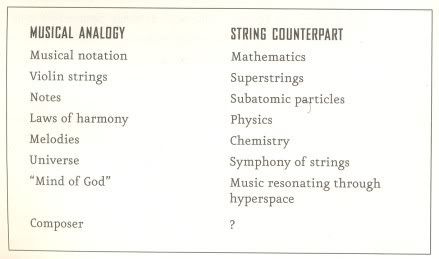
What are scientists attemtping to do? Destroy the world?
Contrary to what some alarmists believe, (some of which have filed lawsuits in an attempt to stop this program), no. It will not destroy the world. This is the biggest misconception. There are cosmic ray collisions that occur daily which deliver "equivalent to one hundred thousand (or one billion)times the total number of collisions expected over the duration of LHC experiments. Analogously, in the whole Universe, the equivalent of 3X10-to-the-13th-power complete LHC experiments are performed every second." [via]
If anyone is worried about Black Holes, Stephen Hawking talks about micro-black holes emitting Hawking Radiation (or Black Body radiation) and lose more mass than they absorb because of the 'Uncertainty Principle' (where virtual particles aren't in any single specific location and are paired together because of entanglement) - when one of the entangled particles hovers gets caught in the Schwarzchild radius (event horizon) it leaves it's partner behind, and if this process is repeated, it shrinks the hole. Some say that his Hawking Radiation principle has never been observed and tested, but just to allay those fears; their effects have been witnessed, and if it turns out to be untrue, these black holes will be so microscopic that they will attract an insignificant amount of force to begin with. Additionally, they will be propelled so fast that they will escrape the grapple of gravity.
(Keep in mind, WE are the oddballs of the universe in comparison with the violent, powerful things that occur every nanosecond throughout the universe. The amount of power that will take place in the LHC is only unfathomable to our minds since it doesn't seem natural to us - but again, solar flares produce more power (on a consistent basis) than this comparatively puny thing will ever do.)
What are they looking for?
In a nutshell, scientists are trying to piece toget
her how our universe came to be, and the only way to do that is to reverse engineer our universe. Thanks to Edwin Hubble, we know that our Universe is currently expanding, and if it's expanding to this day (as made apparent by the red-shift of distant galaxies), then you can imagine if you were able to press a 'rewind' button, it would all come back to a single point.
We know there are four forces that rule our Universe; the electromagnetic, the strong nuclear force, the weak nuclear force, but the weakest of all of these is gravity. This is a problem that has plagued physicists. For as pervasive as gravity is, it seems strange that it's the weakest of them all. For instance, all the gravity of the world pulling down on a paper-clip is easily canceled out by a magnet.
Understanding the particles, and subatomic particles and how they are given mass can only be answered if scientists are able to hit that rewind button. Thanks to Albert Einstein, we know that mass and energy are interchangeable, but how does anything acquire mass to begin with? The expect to find the Higgs Boson that does just that- and if they don't, they won't be entirely surprised.
Why are we here and how did we get here? Is there an edge to the universe? Is it limitless? Why do they think there was a Big-Bang to begin with? Did they just pull that out of their asses just because they don't want to believe baby Jesus did it? So there's a Big Bang theory - so what happened before that? What set it off? Why is gravity the weakest of the four forces even though it is the most pervasive of them?
These are pretty big questions to answer, so to make sense of it all, we'll have to step back in time and put all of this into context.
The Beginning of the madness

Newton
I was surprised to learn that Newton had lain the foundation for differential and integral calculus [1], mainly out of necessity in order to determine the motion of falling objects, which includes moons, and in Principia, he had given an account of the laws of mechanics, laws of motion, govern the celestial bodies, as well as our very own planet. This did much to to demystify the celestial bodies in space, and his contributions, laid out in Principia, did much to pave the way for the Industrial Revolution. Many of the modern day marvels we see today (skyscrapers, rockets, bridges) would not be possible without Newton's laws of motion.
As Michio Kaku points out in his book "Parallel Worlds", thanks to Newton's Principia, "the stage of life was no longer surrounded by terrifying celestial omens; the same laws that applied to the actors also applied to the set."
Newton, the Rockstar of his time, is going down.
However, to say that 'the set' (the universe) followed the same laws that the actors (us) did inevitably brought up many questions about 'the set'.
Newton believed that our Universe was static, and undynamic. He had his reasons, but he also had his dissenters.
Bentley's Paradox (An argument against an infinite, static universe: Is the 'set' (our universe) infinitely large and limitless? If gravity is always attractive, and never repulsive, that would mean the heavens should give us a display of fiery cataclysms everyday as stars would naturally collapse into themselves. So why doesn't this happen then? If the universe were infinite, Bentley wondered, then wouldn't space on either side of a star be equally as strong and rip it to shreds. This would mean that our universe is extremely unstable, like a house made of a deck of cards.
Newton's answer: Newton was plagued with all of the paradoxes brought forth by his theory. However, he found a loophole in Bentley's assumptions. Newton simply replied with the answer that the universe is infinite but it is completely uniform. Therefore any tugging that was applied to a star by an infinite number of stars on one side was canceled out by the same amount of tugging of an infinite number of stars on the other side.
That was enough to quell the argument for the time being, and only for the time being. The problem with Newton's answer to Bentley's Paradox is that it paints a picture of a very delicate and unstable universe, that if it were ever to lean ever so slightly in either direction, it would disrupt the perfectly assumed equilibrium, and set a chaotic chain reaction in motion that would put an end to all of life as we know it. He ultimately attempted to compensate for the fragility of his argument by stating that perhaps God was keeping things perfectly balanced, and had to, on occasion, tweak things so that they wouldn't send the delicate house of cards tumbling. This was tantamount to Newton grasping for straws by retrofitting an explanation to keep his theory intact. This explanation didn't hold much weight for long. Enter Olber's Paradox.
Olber's Paradox and Edgar Allan Poe?
Another argument against Newton's 'static' (unmoving) infinite universe was that if it were true, our night sky should be illuminated by the infinite number of stars within it. In other words, the sky should never be black at night in an infinite, static universe. This paradox has been a riddle to scientists for centuries.
There were several attempts to solve this paradox, some of which appeared to have amounted
to people grasping for straws who were seemingly attempting to assemble solutions around the outcome they desired n attempts to explain away the invoncenient notion of this paradox. Some suggested that dust clouds in space obstructed the light, and others attempted to just do away with the 'infinite' part by suggesting instead that the universe was finite, thus limiting the amount of light from stars that would reach us. However the 'dust cloud' theory was put to rest because it was said that this would light up the dust clouds as well, and in an infinite universe, the light would still reach us.
You might be surprised to find out that the first person to really put a logical explanation behind Olber's Paradox was Edgar Allan Poe. In his poem, Eureka, he said:
Were the succession of stars endless, then the background of the sky would present us an uniform luminosity, like that displayed by the Galaxy - since there could be absolutely no point, in all that background, at which would not exist a star. The only mode, therefore, in which, under such a state of affairs, we could comprehend the voids which our telescopes find in innumerable directions, would be by supposing the distance of the invisible background so immense that no ray from it has yet been able to reach us at all.
He had it exactly right. Light travels at an extremely fast rate. It is often called 'the ultimate speed limit.' But the speed of light is still finite. Our universe is so immense that even with light from the stars traveling at 186,287 miles per second, not all the light in all the universe has reached us. Additionally, the lifespan of stars is not indefinite - even if they can live for billions of years. The farthest we can see is only as far as light has traveled since the Big Bang, which is 13.7 billion years. It has later become known that the sky really isn't black at all - but is the Cosmic Microwave Background radiation from the Big Bang itself fills up the sky! If our eyes were wired to see radiation, they would, and we would see a lot more than we're currently able to see.
What's "Cosmic" about it? We refer to it as "cosmic" because the only known source of this radiation is the early universe. It can now be firmly concluded that the CMB is the cooled remnant of the hot Big Bang itself.
Cosmic Microwave Background - FAQs
Take a look at this diagram below and the image of the actual Cosmic Microwave background beneath it.
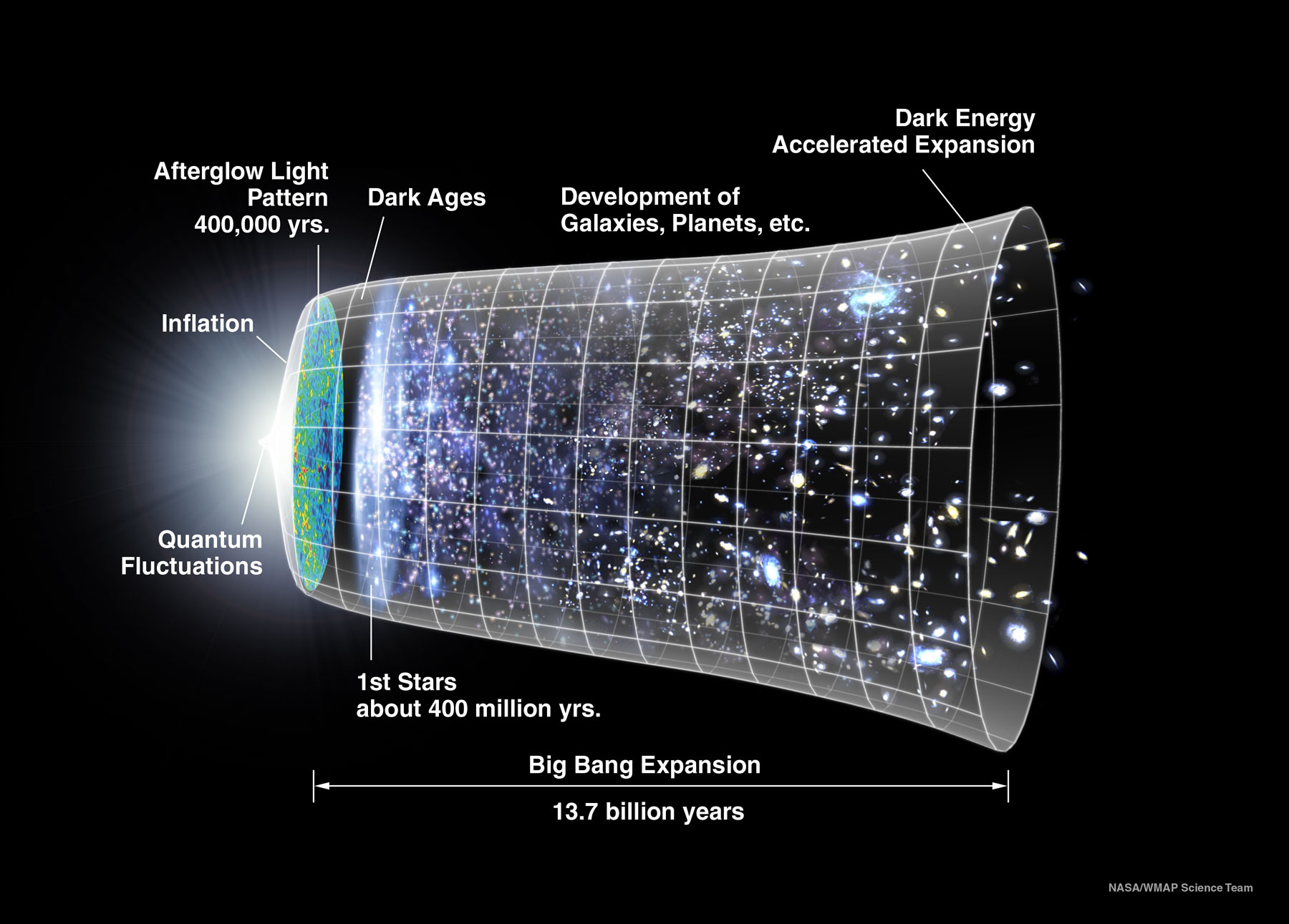
To understand the significance of this, I leave you with a quate from Michio Kaku:
To describe the universe, cosmologists sometimes use the example of looking down from the top of the Empire State Building, which soars more than a hundred floors above Manhattan. As you look down from the top, you can barely see the street level. If the base of the Empire State Building represents the big bang, then, looking down from the top, the distant galaxies would be located on the tenth floor. The distant quasars seen by Earth telescopes would be on the seventh floor. The cosmic background measured by the WMAP satellite [shown below] would be just half an inch above the street. And now the WMAP satellite has given us the precise measurement of the age of the universe to an astonishing 1 percent accuracy: 13.7 billion years.
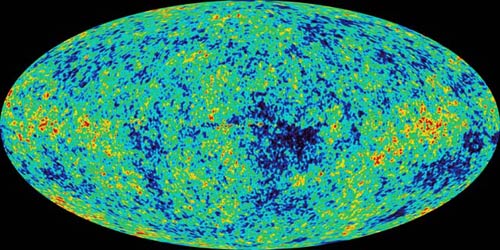
To the unaided eye (mine included) this WMAP image looks rather boring. But this image itself, when first produced, was said to bring many astronomers close to tears. For this image above represents irregularities of the big bang itself, shortly after the universe was created.
As Stephen Hawking stated this in response to many saying the multi-billion dollar cost put toward this is a waste of time and money:
"Both the LHC and the Space program are vital if the human race is not to stultify and eventually die out. Together they cost less than one tenth of a per cent of world GDP. If the human race can not afford this, then it doesn't deserve the epithet 'human."


